


Residential Strata Insurance Victoria: Protecting Strata Title Properties
Key Takeaways
- Residential strata insurance Victoria mainly covers the shared risks of the strata title properties rather than the individual personal belongings.
- Insurance usually covers the common areas, common contents, and the insured events.
- Policy features, optional covers, and insurance premiums change depending on the property and the financial situation.
- Information provided by strata insurance specialists is general in nature and should be checked against official documentation.
This article provides general information only and does not take into account your objectives, financial situation or needs. Before making any insurance decision, consider the relevant Product Disclosure Statement.
Residential strata insurance Victoria is currently one of the most significant factors in the protection of strata title properties against a variety of shared property risks. A strata titled property, be it an apartment block or a townhouse, generally creates a complex situation involving multiple stakeholders, shared responsibilities and collective decision-making. Knowing how residential strata insurance Victoria generally works can help lot owners, Body Corporate Committee members and strata managers become aware of common insurance issues - but one should never assume that what fits one property will also fit another property.
This information is general in nature and does not take into account your individual circumstances. Different policies and insurers offer different coverage, terms, and conditions. Always consult the Product Disclosure Statement (PDS) for the relevant product.
What Is Residential Strata Insurance in Victoria?
Residential strata insurance Victoria mainly points to insurance setups for strata title properties where several lot owners together share the ownership of the common property. The owners' corporation or strata company usually holds these policies, not the individual owners.
On the other hand, individual lot owners may have home or landlord insurance for their personal belongings or rental income, but a strata insurance policy is generally designed to cover shared assets, liabilities, and responsibilities under a strata plan.
Since coverage needs differ based on building style, location, and the owner's financial status, this is one reason policies are reviewed regularly.
Understanding Strata Title Properties and Their Insurance Needs
Definition and Importance of Strata Title Properties
Strata title properties are developments in which individual lots are sold to private owners, with common areas such as stairwells, lifts, roofs, and sometimes swimming pools owned collectively. These shared features bring insurance requirements that differ from those for standalone houses.
Coverage for Common Areas and Common Area Contents
Residential strata insurance typically covers common areas and common area contents, including shared fixtures and fittings. Examples of common contents might include lighting, hallways, or equipment installed in shared areas.
Role of the Strata Plan in Determining Coverage
The strata plan generally outlines the demarcation between the private lot and the shared property. Such a document can determine what a strata insurance policy covers and what individual owner insurance policies might cover.
Key Benefits of Residential Strata Insurance Cover
Protection from Accidental Damage and Water Damage
Strata insurance policies generally provide protection against accidental damage or water damage incident to property owned in common. The extent of coverage and the list of exclusions may vary depending on whether the damage is due to normal wear and tear.
Coverage for Shared Facilities and Common Contents
Depending on the policy terms, common contents coverage may extend to shared items such as a washing machine in a communal laundry or the equipment supporting a swimming pool.
Support for Voluntary Workers and Body Corporate Committees
In some cases, residential strata insurance includes a provision that covers voluntary workers who supply their services to the strata company or the Body Corporate Committee in an official capacity.
Temporary Accommodation and Loss of Rent
If an insured event renders a building unfit for human habitation for a period, several policies may provide for temporary accommodation or loss of rent, subject to limits and conditions.
Policy Covers, Optional Covers, and Compliance Tools
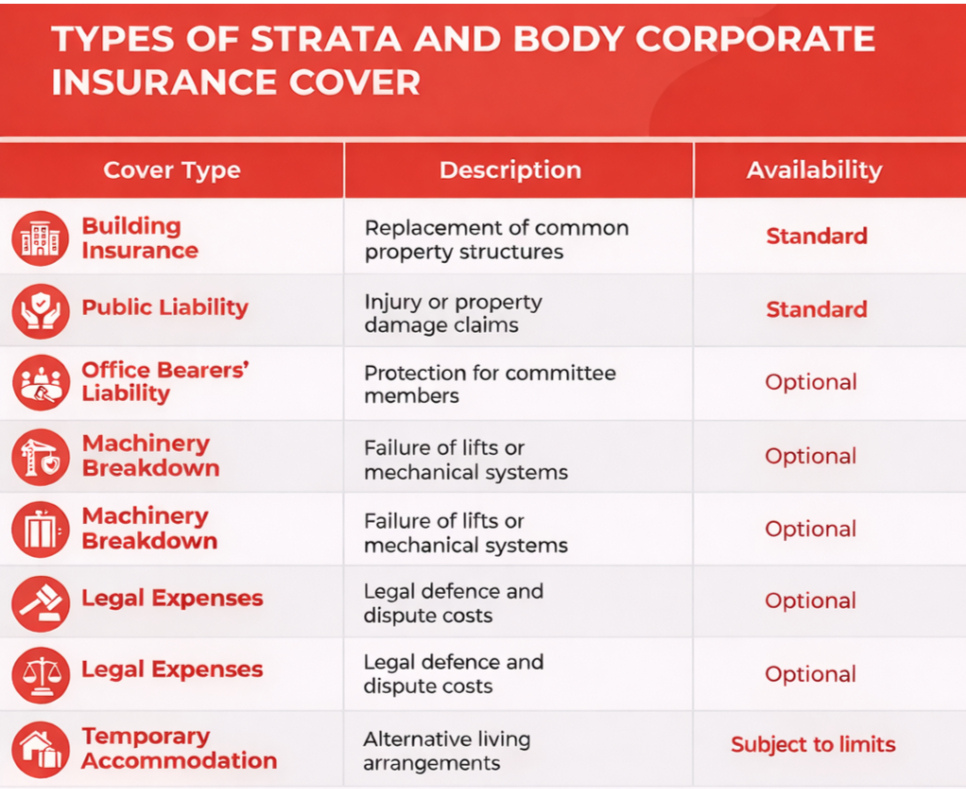
Strata policies very often revolve around the Home Building and Property Insurance aspect, both of which are generally covered at replacement cost.
The insurer determines whether machinery breakdown, legal expenses, and office bearers’ liability claims can also be included.
Office bearers' cover is an insurance policy that protects committee members or office bearers from liability claims arising from their duties.
Optional Covers to Enhance Your Strata Insurance
Optional covers may be storm surge, emergency assistance, or Legal Defence Expenses. The availability, eligibility criteria, exclusions, and benefit limits for optional covers vary between insurers and must be reviewed in the relevant Product Disclosure Statement. Certain strata insurance options can also be tailored to allow individual lot owners to hold both Landlord Insurance and home insurance.
In some cases, there may also be coverage extensions concerning HR banking, technology platforms, or Company Secretary functions.
How to Choose the Right Strata Insurance Providers
Strata insurance specialists often work closely with strata managers and committees, and thus they explain the different options for coverage, insurance premiums, and policy covers, without considering individual circumstances. This information does not constitute personal financial advice.
Target Market Determination documents specify a product's intended audience and help customers make informed choices. Going through these together with data insights and group purchasing arrangements can be a helpful tool for strata companies when evaluating several insurance quotes, without implying suitability for any specific situation.
Why VIM Cover Is Often Considered
VIM Cover is a strata insurance broker that is part of the Steadfast Network brokers framework and is in partnership with the recognised strata insurance providers such as CHU Underwriting Agencies Pty Ltd (ABN 18 001 580 070) and CHU Underwriting Agencies. These contracts take place within the larger Steadfast Group Ltd (ABN 98 073 659 677) network.
With the help of compliance tools, technology platforms, and data insights, VIM Cover is committed to providing strata managers and committees with excellent customer service, compliance support, and the fastest possible answer to general queries. VIM Cover does not provide personal advice unless expressly stated and operates in accordance with its Australian Financial Services Licence obligations. The information provided is supported by a Financial Services Guide and the relevant Product Disclosure Statement.
Ensuring Comprehensive Protection for Your Property
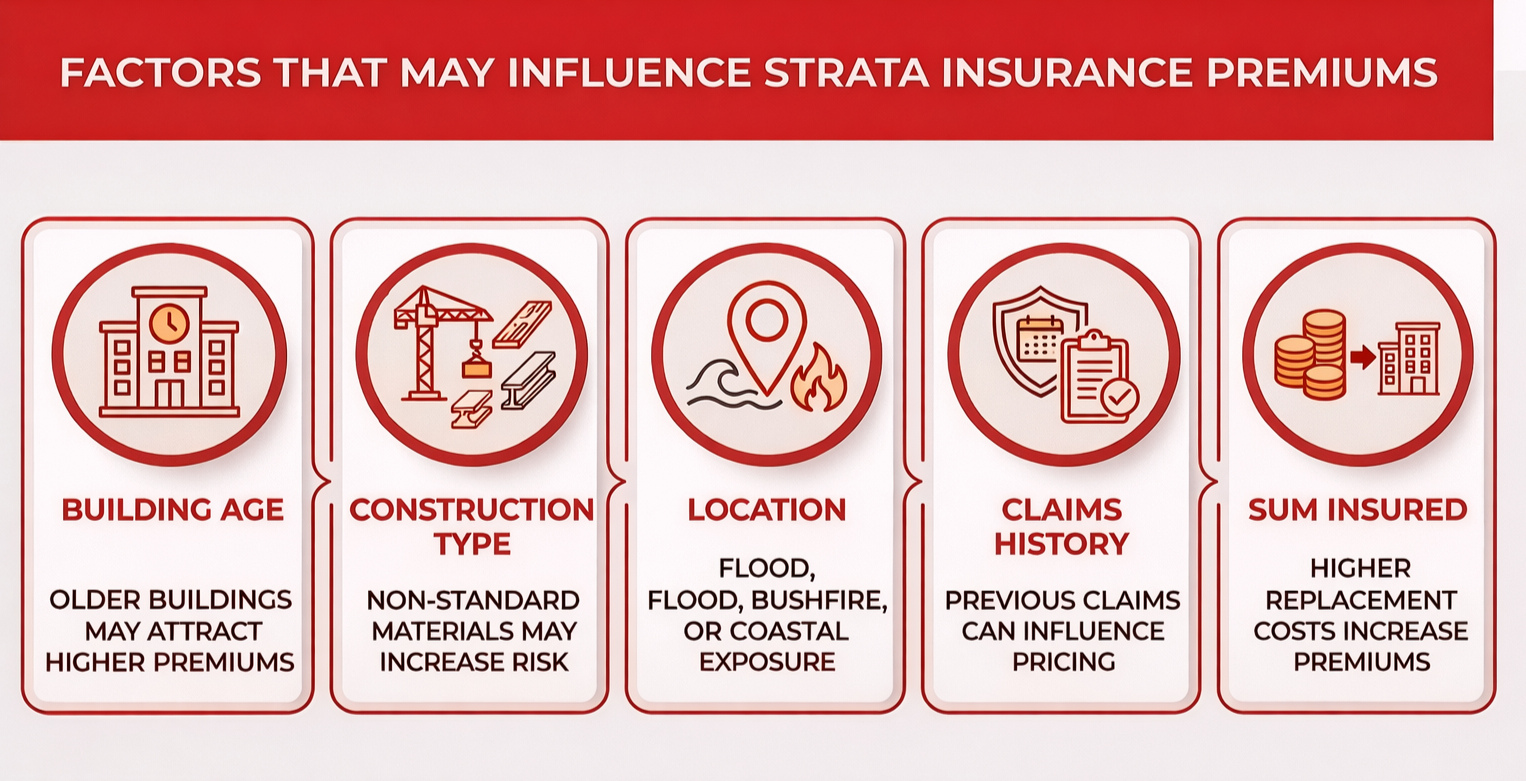
As Victoria's property landscape changes, apartments and strata title properties continue to present a wide range of insurance needs. A review of Residential Strata Insurance Cover each year might help strata companies stay familiar with changes in insurance coverage, Government audit costs, and changes in insurance premium values.
Continuously engaging with well-versed strata insurance agents may help to identify gaps in coverage, not just assuming that entirely risk-free coverage is always available.
Frequently Asked Questions
Q1. Does residential strata insurance replace home insurance?
A1. Residential strata insurance covers communal or shared property, whereas home insurance primarily covers personal belongings within individual units.
Q2. Are lot owners required to have separate insurance?
A2. Lot owners considering separate home insurance or Landlord Insurance will depend mainly on the usage and rental agreement.
Q3. Does a strata policy cover machinery breakdown?
A3. Certain strata insurance policies provide machinery breakdown cover, but this is subject to terms and conditions and exclusions.
Q4. Who manages the strata insurance policy?
A4. The insurance is usually arranged by the Body Corporate Committee or the strata company through the strata manager.