Comprehensive Guide to Residential Strata Insurance in NSW
Key Takeaways
- Residential strata insurance NSW is in most cases a legal requirement for any strata-titled property as per NSW legislation.
- Normally, coverage is focused on communal facilities, common areas, and the building, with risks considered rather than individual contents.
- The policy features and optional covers may vary depending on the characteristics of the strata scheme and the specific insurer’s policy terms and conditions.
- In fact, a professional can help with documentation and compliance requirements within the scope of general information or services permitted under Australian law.
Residential strata living is one of the most popular features of the New South Wales lifestyle, particularly in apartment blocks, townhouses, and shared residential developments. Because more parties are involved, such as lot owners, committee members, and a strata manager, the insurance arrangements are usually more complex than those for a typical home. This guide explains residential strata insurance in NSW using straightforward, general, and law-friendly language so that readers can get a clear and accurate comprehension.
This information is general in nature and does not take into account your personal objectives, financial situation, or needs.
Understanding Residential Strata Insurance in New South Wales
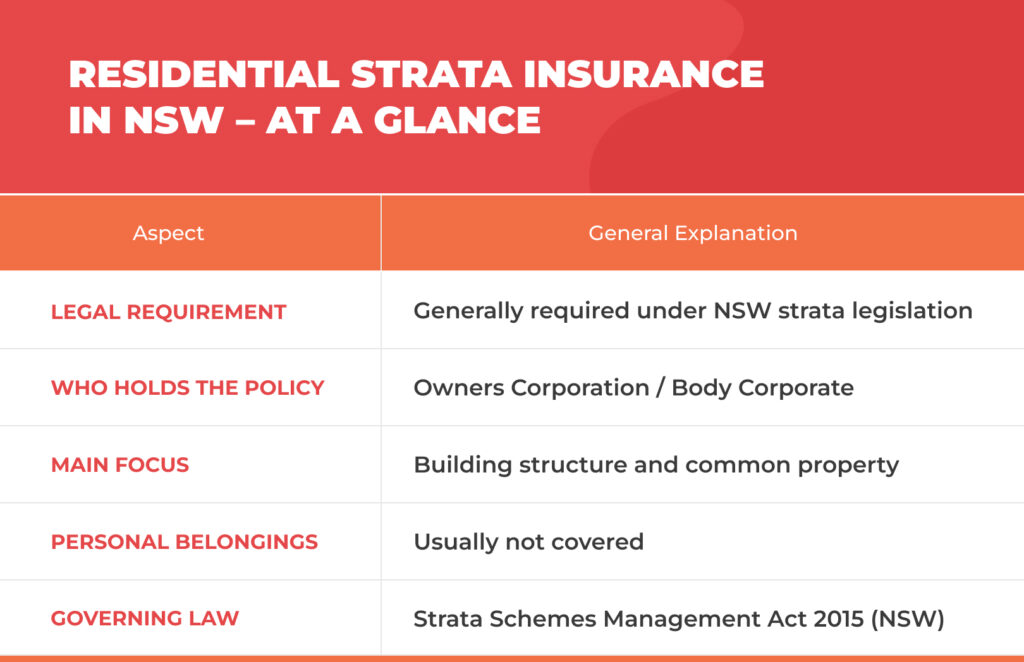
Residential strata insurance covers shared risks arising out of strata titled properties. In NSW, such arrangements are regulated by law and are generally implemented by a strata company or body corporate, sometimes with assistance from a professional property manager.
What Is Strata Insurance?
Strata insurance is a policy that primarily covers strata title properties. It is usually mandated under the Strata Schemes Management Act 2015 (NSW). The insurance can cover the property’s structure and amenities, such as common areas and conveniences available to all residents. Insurance generally does not cover the personal belongings of individuals living in the units, known as ‘lots’.
Strata insurance is, in most cases, a separate insurance from the insurance an individual takes for their home, which generally covers the stuff inside the home.
Who Benefits From It?
Residential strata insurance is pretty much a common theme for:
- House owners residing in strata dwellings
- The body corporate who ensures that all obligations are met
- Strata managers are responsible for the daily administration
- The members of the committee and the office bearers who represent the scheme
Start your Quote today!
Key Features of Residential Strata Insurance
Having a clear idea of what is typically covered and what might be optional will definitely help you understand the structure of these policies.
Coverage Inclusions
Although the exact details differ depending on the provider and risk profile, residential strata insurance is generally concerned with:
- Home Building items and the physical building structure
- Common area contents, such as shared fixtures
- Storm, water, accidental, and malicious damages
Insurers typically do not cover problems caused by wear and tear, as these are generally considered maintenance issues.
Optional Covers and Extensions
Some optional covers that may be available under certain policies include:
- Machinery breakdown cover (e.g. lifts, shared pumps, or air-conditioning units)
- Catastrophe insurance for major insured events
- Pools and related infrastructure protection
The availability and scope of optional covers depend on the insurer, underwriting criteria, and policy terms and conditions.
Additional Benefits Commonly Considered
Residential strata insurance policies may also include, subject to the policy:
- Accommodation in case of necessity and Loss of rent after insured events
- Cover for volunteer workers helping the strata scheme
- Office Bearers liability and Legal Defence Expenses
- Property Damage Liability in the case of shared areas
In some cases, certain administrative or regulatory costs may be included, depending on the policy wording.
The Role of Strata Insurance Specialists

Many schemes engage a strata insurance specialist to provide support with understanding and administration, given the regulatory environment and diverse building designs.
Why an Insurance Broker Is Usually Involved
An insurance broker may assist by providing general information only, unless otherwise disclosed, including:
- Identifying the general advice boundaries
- Helping with insurance quotes and a Strata Insurance quote
- Ensuring Target Market Determination alignment
- Offering access to compliance tools and data insights
Before arranging any insurance, brokers generally provide a Financial Services Guide (FSG) and refer clients to the relevant Product Disclosure Statement (PDS), which should be reviewed carefully before making any decisions.
Industry Partnerships and Market Structure
Some brokers operate within broader industry networks. For example, VIM Cover is a member of the Steadfast Network, which is associated with the Steadfast Group Ltd, and may work with specialist underwriting agencies such as CHU Underwriting Agencies Pty Ltd.
This information is provided for general market awareness only and does not constitute a recommendation or endorsement of any specific broker, insurer, or underwriting agency.
Such agreements can facilitate a wider range of underwriting skills for strata properties in NSW and South Australia. Various entity codes may include ABN 18 001 580 and ABN 98 073 659 677, depending on the entity involved.
Steps to Secure the Best Strata Insurance Policy
Important Considerations for Strata Committees
Before reading the insurance policy or renewing it, a committee generally takes into account:
- The scheme’s total financial health
- Age of the building, type of construction, and communal facilities
- Claims record and risk profile changes
Sometimes, a committee member may coordinate with a strata manager to ensure that the documentation stays in line with the legislation and insurer requirements.
FAQs
Q1. Is residential strata insurance compulsory in NSW?
A1. Generally, the legislation requires that strata schemes in NSW maintain insurance for the building and the common property.
Q2. Does strata insurance replace home insurance?
A2. Strata insurance usually covers common/shared property, whereas home insurance covers items inside individual lots.
Q3. Are washing machines included in strata insurance?
A3. It appears that fixed infrastructure could be treated differently from appliances such as washing machines, which are usually considered personal property. Coverage depends on how items are defined in the policy wording.
Q4. Who is responsible for the strata scheme insurance?
A4. It is typical for the body corporate or strata manager to arrange this, and at times they may be assisted by an Insurance Broker acting within the scope of their authorised services.